
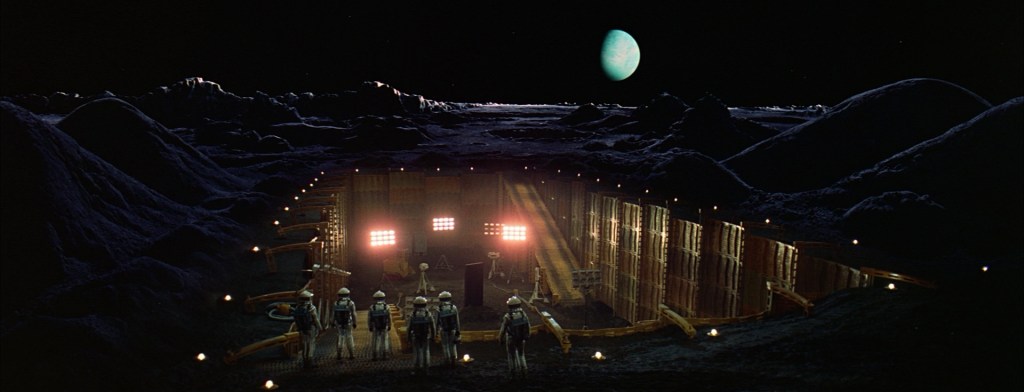
I finally got around to reading 2001: A Space Odyssey by Arthur C. Clarke this year. The book explains the story better than the film and despite the characters lacking depth, it brings up some very interesting ideas about the future of humanity.
However, when I was around halfway through the book, something became strikingly clear – 2001: A Space Odyssey is sexist. Really sexist. Sure, it was written in 1968, but if we don’t want to make certain groups of people feel unwelcome in science and technology, this sort of thing needs to be called out whenever and wherever it happens, even if it’s in our most treasured science fiction.
So, what did I find?
1. There are four named female characters in the entire book
We meet Miss Simmons, the fussing stewardess. Miss Fleming, Dr Floyd’s housekeeper, is mentioned by name only. On the Moon we encounter Diana, a four year old child. Finally Mrs Poole, Frank’s tearful mother, appears briefly later on.
And that’s it.
In contrast, you can find four, named, male characters speaking to one another in a single scene. It’s also worth noting that while these four female characters are named, they only have either a forename or surname. Many male characters in the book have both.
2. The female reporter isn’t respected by Floyd, but the male ones are
When Dr Floyd is walking towards his transport to the Moon, several reporters ask him about his classified mission. Male reporters Jim and Mike “asked” Floyd questions and Floyd apologised and politely explained that he couldn’t give them answers. However, the only female reporter is treated to this:
“”Dr Floyd,” demanded a very short and determined lady of the press, “what possible justification can there be for this total blackout of news from the Moon? Has it anything to do with the political situation?”
“What political situation?” Floyd asked dryly.”
Arthur C. Clarke, 2001: A Space Odyssey (1968)
It’s subtle, but this sort of differential treatment is still surprisingly common. Women often find themselves being ignored (or even patronised) for something they say, while their male counterpart would be respected or even praised for saying the exact same thing.
3. Female characters get stuck with gender stereotypes
The stewardess fussed over Floyd during the flight. He thanked her and he “caught a glimpse of a slightly embarrassed but charming smile”. She later mentions her fiancé and how worried she is about his being on the Moon during the quarantine.
The journalist, only trying to do her job, gets depicted as “determined” and pushy. Mrs Poole’s only line is “Take care, darling. God bless you”, and this is delivered “tearfully”.
Just look at those words again: “fussed”, “embarrassed”, “worried”, “tearfully”. 2001: A Space Odyssey tells us women are weak and if, like the journalist, they don’t conform, they are criticised for it.
4. Women don’t experience weightlessness
Arthur C. Clarke’s style of writing hasn’t aged well. Reading the text as a woman, you do begin to wonder whether the author thinks women actually exist as sentient beings affected by gravity.
“A man who weighed one hundred eighty pounds on Earth might be delighted to discover that he weighed only thirty pounds on the Moon. As long as he moved in a straight line at a uniform speed, he felt a wonderful sense of buoyancy.”
“Like all scientifically literate men,”
“In the fifty years since men had ventured into space,”
Arthur C. Clarke, 2001: A Space Odyssey (1968)
Perhaps bringing attention to this may be seen by some as pedantic, but it’s still a problematic way to write — you read it all the time in famous scientific texts (e.g. Feynman’s lectures, though admittedly he’s not a shining beacon of gender equality) and, deliberate or not, addressing literature solely to men can and does make women feel unwelcome.
5. A base of 1700 highly trained scientists and the women are “girl assistants”
This one baffles me. When Floyd arrives on the Moon, we are told there are 1100 men and 600 women at the base, all of whom were “highly trained scientists or technicians, carefully selected before they had left Earth”. However, we do not encounter a single female scientist.
Once inside the base, “Floyd found himself back in the familiar environment of typewriters, office computers, girl assistants, wall charts and ringing telephones”.
“Girl” assistants? Women implied to be of the same status as furniture? Frankly, I am glad Arthur C. Clarke’s idea of what 2001 would be like for women was not completely accurate…
6. The Discovery’s space pods are female, but not for a good reason
This is the part of the novel that inspired me to write this article.
“They [space pods] were usually christened with feminine names, perhaps in recognition of the fact that their personalities were sometimes slightly unpredictable. Discovery’s trio were Anna, Betty and Clara.”
Arthur C. Clarke, 2001: A Space Odyssey (1968)
Sorry, but I’m not laughing. Encouraging women to pursue and maintain careers in typically masculine industries is difficult enough without putting them off even more with this nonsense.
In 2001, it’s suggested that women aren’t worthy of both forenames and surnames, or even a role important to the plot. They’re emotional, irrational, inferior and considered part of the office furniture. They’re disrespected when they try to do their job, and excluded from the narrative by the use of male pronouns. A cheap sexist joke is just the cherry on top.
Image from 2001: A Space Odyssey, 1968 film. This post has been restructured and edited for flow and clarity.


 Nikki Miller, PhD
Leave a comment