
My research can be broadly described as developing and applying cutting-edge techniques to a wide range of observational data, in order to help us understand the life cycles and processes of stars that host exoplanets.
I am interested in solar-type and M dwarf stars, eclipsing binaries, exoplanets, photometry, spectroscopy, space-based and ground-based observations, data reduction, machine learning, and astronomical instrumentation.
Solar-type eclipsing binaries
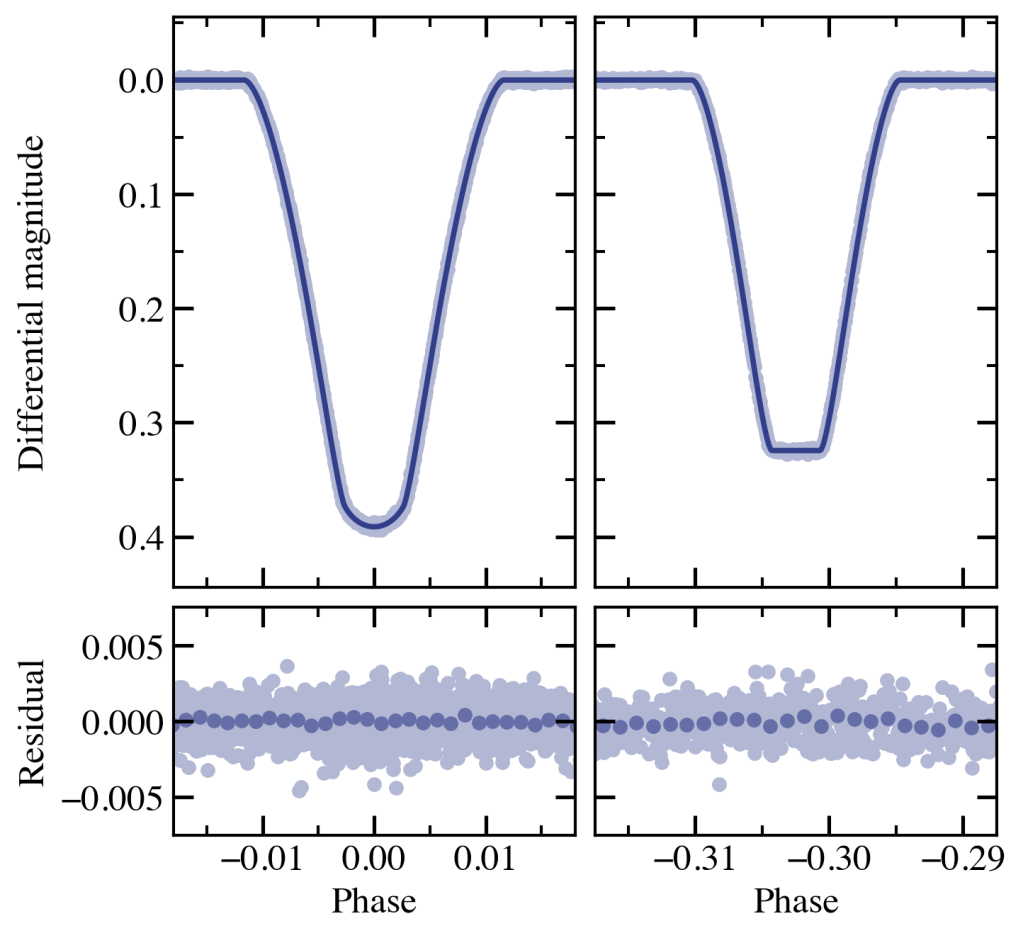
Detached eclipsing binaries are uniquely useful: model-independent masses and radii can be measured to otherwise unattainable accuracy and precision, and yet the component stars undergo evolution “as if they are single stars”, i.e. no mass transfer or significant tidal effects. They are also born at a common time, distance and initial chemical composition. I am particularly interested in improving how we measure the effective temperature for these systems. I developed a method for this during my PhD along with Pierre Maxted, “TEB”, which has been used to characterise stars in 13 binary systems across ~9 publications so far. TEB is implemented in open-source Python code.
Stellar spectroscopy with machine learning
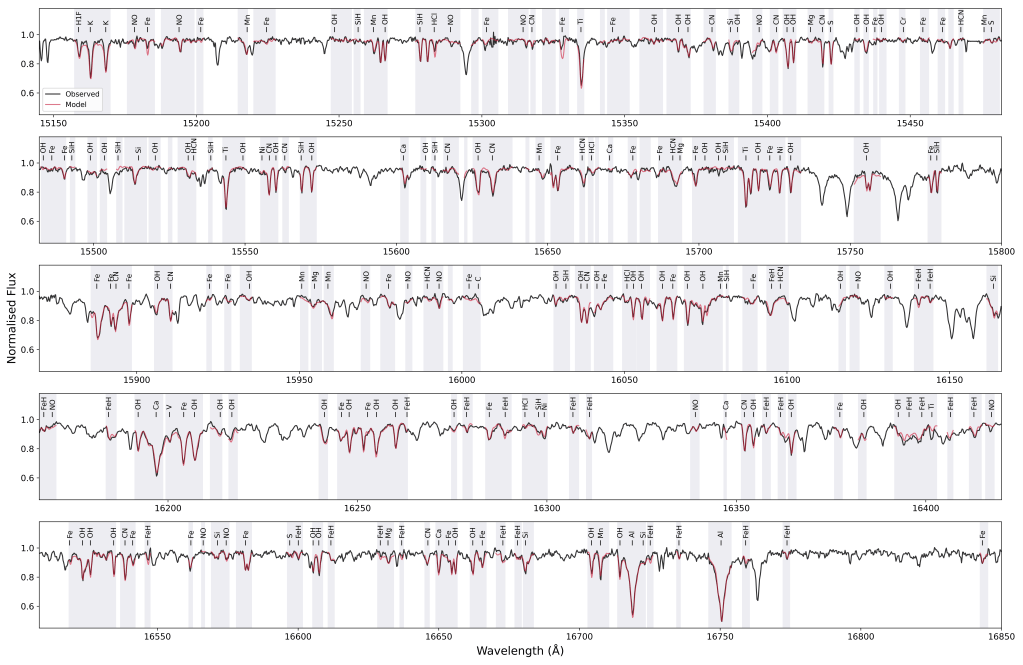
The PLATO mission is an upcoming European Space Agency mission that aims to discover and study Earth-like planets orbiting Sun-like stars (launching early 2027). PLATO will also observe at least 5000 M dwarfs, which present unique observational and modelling challenges. I am developing the pipeline which will homogeneously measure the physical and chemical properties of all M dwarfs observed by PLATO! We use a neural network trained on MARCS model atmospheres to obtain atmospheric properties and chemical abundances from near-infrared spectra, and a Bayesian framework for comparing observed photometric data with state-of-the-art BASTI stellar evolution models.
Benchmark stars
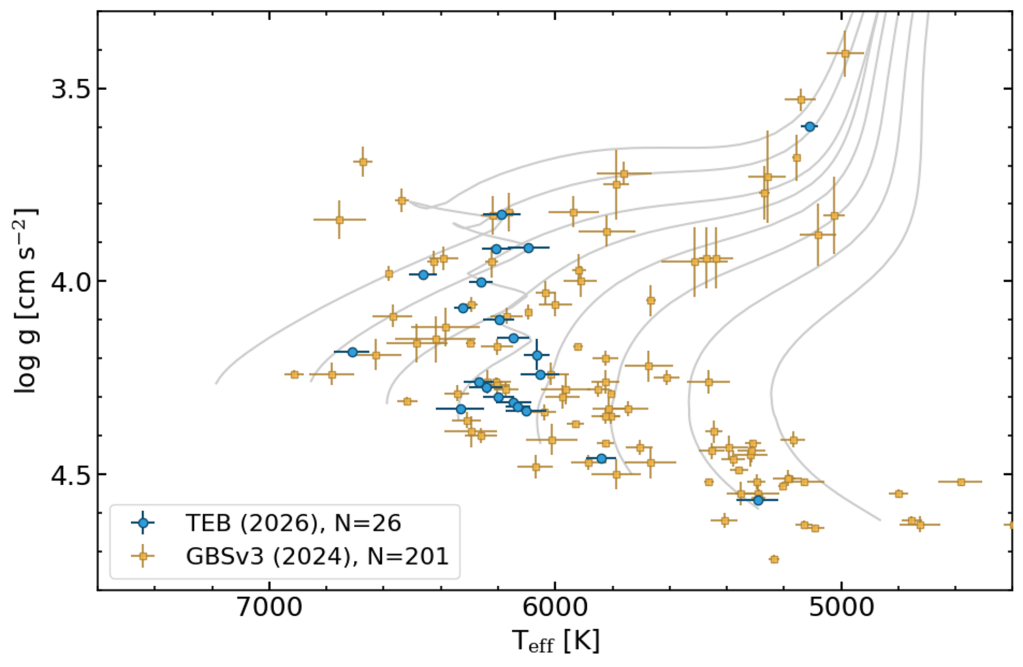
Detached eclipsing binary stars have strong potential as benchmark stars, i.e. can be used to test, calibrate, and validate all kinds of pipelines, empirical relations, and theoretical models. As we enter an era where vast quantities of data are observed faster than we can look at them, having a reliable set of “truth” values for stars becomes more important than ever. I am involved in the team behind the PLATO Benchmark Stars catalogue, for which we have compiled and standardised samples of well-characterised stars based on the needs of the PLATO consortium.
Instrumentation projects

Xamidimura is the next iteration of WASP-South, but for binaries. I wrote an autonomous scheduler and was involved with commissioning the telescopes in South Africa. Read more.
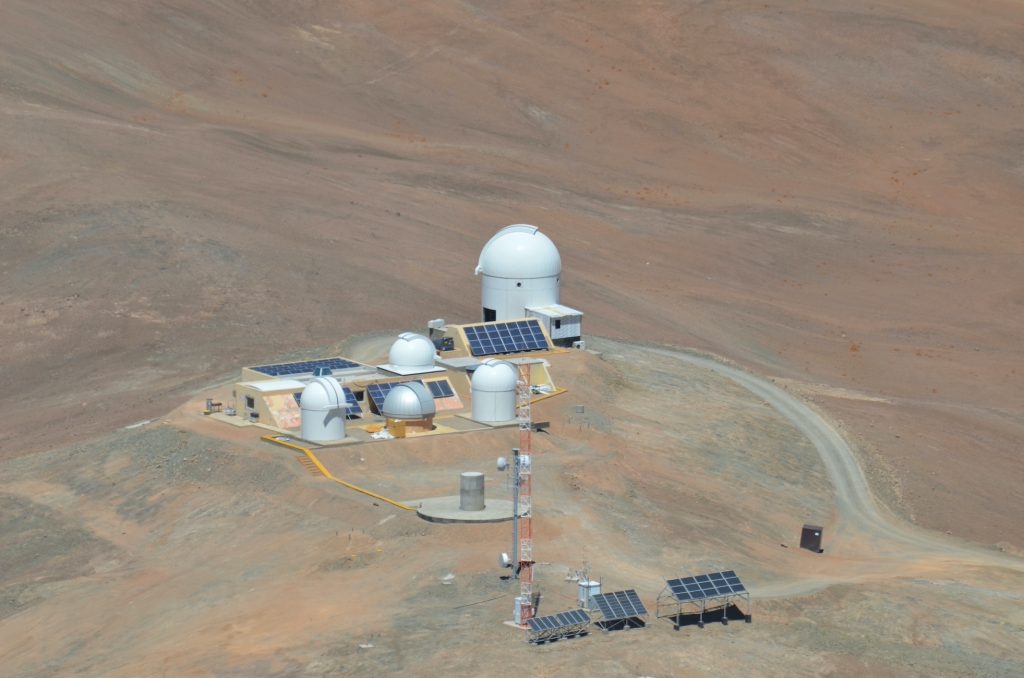
One mountain over from the E-ELT is OCM, an observatory operated by the Araucaria Project. During my time at CAMK I helped with commissioning, operations and the development of observing programmes.
 Nikki Miller, PhD