
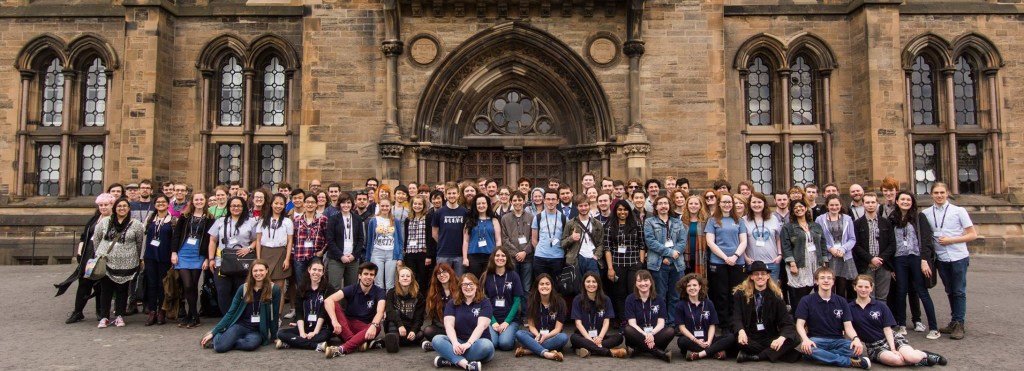
A few weeks ago, I attended the Conference for Astronomy and Physics Students 2016 (CAPS), which was hosted by students at the University of Glasgow. It was not my first undergraduate conference, but it was most certainly the most enjoyable one I’ve been to! I thought I’d share my experience for two reasons: one, to let other students know about CAPS, and two, so that I can remember every small detail for years to come. Sorry if it’s a little long.
Thursday 23rd June
I arrived towards the end of registration (having spent the day searching for an outfit for Saturday – more on that later), so quickly dropped my belongings and sped off to meet the rest of the group.
After a pleasant meal speaking with delegates from Dublin City University and the Open University, we walked to the Queen Margaret Union (QMU) for a quiz. Four teams, including mine, named themselves “the Quizzicists”…
Friday 24th June
The conference woke up to the news that the UK had voted to leave the European Union… not the best start to the day. However, I can think of no better people than over 100 young scientists to absorb and discuss the vote with.
Friday’s talks were kicked off by Dr. Aidan Robson, who spoke on “The Large Hadron Collider, the Higgs boson, and beyond“. Although I’m not a particle physicist, his use of snooker ball analogies and incredible facts – e.g. in the LHC, the temperature is kept lower than that of interstellar space, yet collisions reach temperatures hotter than the surface of the Sun – made the subject truly absorbing.
This was followed by a series of student talks. Mindaugas Šarpis spoke about his decision to take part in a 500km Arctic expedition (illustrated with stunning photographs). Dewan Woods shared his research into metamaterials and how they can be used to make really efficient light bulbs.
Next, lunch and a careers fair. I learnt about RAS membership (something I’m now considering), spoke to members of the University of Glasgow’s oSTEM and WiSTEM groups (both fantastic organisations) and the IOP USN about opportunities for Warwick Astronomy Society. I also picked up some really useful booklets produced by the IOP about careers and PhDs.
Back to student talks. Edward Birsall gave a quick tour of Noether’s theorem; Lucy Thomas discussed the physics of hearing and how the brain does Fourier transforms for us; Nader Khonji spoke on his work exploring simple harmonic motion; Raeesa Parker shared her measurements of an exoplanet transit taken using UCLan’s new 0.7m telescope; Sija Gao discussed experimental evidence that a photon is able to interfere with itself; and finally, Gabriel Jose Goulart Cardoso spoke about geometric quantization of free particles and fields, but at this stage in my degree I sadly found the subject material a bit beyond me.
The final guest lecture of the day was entitled “What can a Quantum Camera do?” and gave a fascinating insight into a subject I’d never encountered before. Prof. Miles Padgett explained that while regular cameras take in a million photons per pixel, quantum cameras take in <1. The potential of these cameras is incredible – for example, they can track the size, location and motion of objects around corners!
Dinner was really enjoyable; I sat with two delegates from the University of Glasgow (who turned out to be from the same town I am!) and one from UCL, discussing the EU referendum and what it means for us. The planned speaker for the evening had to pull out at the last minute, so instead we were given three marvellous impromptu talks by Laurence Datrier, Zachary Bevan and Danielle Harper on science in film. These were followed by a guest panel of physicists and socialising in the Glasgow University Union bar before heading back for the night.
Saturday 25th June
The day began with a visit to the Glasgow Science Centre. We spent the morning there, watching a fantastic planetarium show and playing with all of the exhibits – including virtual reality goggles!
Prof. Sheila Rowan began the afternoon with “Catching gravitation waves: a new astronomy“, speaking about the tremendous feat of engineering that is LIGO and what gravitational waves can tell us about violent astronomical collisions. This fascinating talk was followed up by student Fraser Baird sharing how he turned his outreach idea (high altitude balloons) into reality with STFC funding. Next, Katie Marshall spoke about her PhD investigating the decay of the Higgs field.
The final guest speaker of the conference, Dr. Heather Williams, gave us an overview of the role of medical physics within the NHS – there are 55,000 healthcare scientists behind the scenes! Dr. Williams also spoke in depth about her Positron Emission Topography specialism, career path, and gave some valuable advice on the importance of work experience.
Two student talks wrapped up the scientific content of Saturday: Joseph Taylor on the importance of foundation years and my favourite student talk of the conference, “Modelling Asteroids: A detailed study of the methods for producing 3D models of asteroid systems from photometric data” by Helen Chamberlain. Using the variable light from asteroids (due to rotation about their axis), it’s possible to work out their shape using 3D inversion tools. Isn’t that incredible?! Check out some 3D models of asteroids here.
The highlight of Saturday was the Champagne Supernova. Conference delegates dressed in formal* attire, were greeted at the Hilton with a champagne** reception, then proceeded to have a 3 course meal (with haggis) and ceilidh! It was a wonderful evening, and I’m very grateful that the half-Glaswegian, half-Sussex accent I developed later that night didn’t fully stick (fun fact: I had a Glaswegian accent when I was younger but lost it over a decade ago… or so I thought).
Sunday 26th June
After an early start, we gathered for the final two talks of CAPS ’16. Brandon Kelly gave an unexpectedly interesting talk about his work in the field of beam splitting in quantum computing, and Vasilije Perovic discussed the methods and difficulties of detecting meteors in the frequency range of 3-30Hz using a ground-based Schumann antenna.
We proceeded to brunch (which was fantastic) and then to the University grounds to take group photographs before myself and two other Warwick delegates left the conference early. We later learned that the bid for CAPS ’17 was won by UCL – congratulations!
Reflections
I found this conference incredibly valuable because it reminded me how awesome studying physics and astronomy can be. I made some contacts that I’m sure will prove valuable in the future. I shared and received ideas about outreach, diversity and how to run an astronomy society, all of which have inspired me to make amazing things happen.
Thank you ever so much to the CAPS ’16 committee; you did an amazing job.
*I’m fairly sure I saw some denim and Converse shoes.
** The student version of champagne, which is, in fact, simply wine.
Featured photo: taken by Christy Nunns.
 Nikki Miller, PhD
Leave a comment