
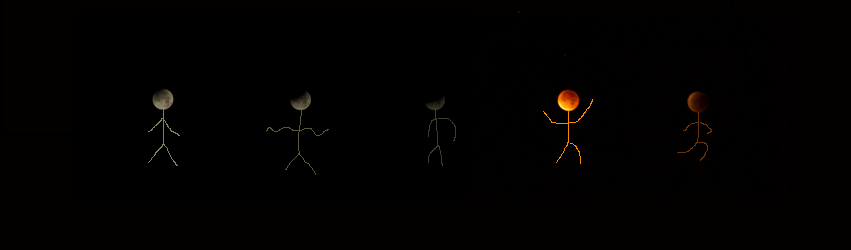
The Moon is great. It gives the Earth tides. It’s a great astrophotography target. It was the setting of the first ever science-fiction film. However, it’s also been the subject of a lot of misunderstanding. Exciting-sounding jargon is thrown about in the news with either incorrect, or no, definitions. Whenever any minor astronomical event occurs, widespread media panic ensues. Recently, it’s come to light that certain influential people don’t quite understand that the moon causes tides.
This article will attempt to dispel myths, define bizarre terminology and clarify what causes the natural phenomena that have been the source of centuries of speculation.
Tides
The Sun isn’t the main cause of tides – despite what one of the UK’s Members of Parliament might think. The gravitational attraction between two objects decreases with distance, according to Newton’s universal law of gravitation:

(where F is the gravitational force, G a constant, M and m the masses of the two objects and r the distance between them). Let me introduce the concept of a tidal ratio:
Tidal ratio = Force on near side / Force on far side
In order for a tidal ratio to be large, there must be a quick drop off in gravitational force strength over a small distance – i.e. stretching the Earth more. Newton’s law of gravity is an inverse square law, which means the strength of a gravitational force drops off quickly close to the object (here, the Sun/Moon) and less quickly the further away you get. So, as you might have guessed, the tidal ratio for the Sun is much smaller (weaker tidal forces) than it is for the Moon.

Now we’ve established that the Moon is the dominant force in creating the tides, let’s take a look at how this actually works. The gravitational pull of the Moon attracts water on the closest side of the Earth the most (and water on the opposite side the least). This causes the water around the world to bulge in two places, creating two areas of high and low tides. The tides change from high to low, and vice versa, with time because the Earth rotates on its axis every 24 hours, causing the relative position of the Moon to change.
But… while the Sun is not the dominant force for the Earth’s tides (only 44% as strong as the Moon), it can still play a role in making them higher or lower. When the Moon and Sun line up with the Earth, they cause a constructive superposition of tides – i.e. very high and very low tides – known as spring tides. When they are at right angles to one another, they cause a destructive superposition – i.e. less high and less low tides – known as neap tides.
Eclipses
Lunar Eclipses
There are several different types of lunar eclipses, but the principle is similar for all – the moon enters the Earth’s shadow for a short period of time and visibly changes its appearance.

- Total lunar eclipse – Moon passes completely through the umbra (darkest part of Earth’s shadow), dims and appears to turn red. This red hue is caused by Rayleigh scattering of the Sun’s light through the atmosphere – the same phenomena responsible for the sky being blue and the reason the Moon looks more orange/yellow when it’s close to the horizon.
- Partial lunar eclipse – Moon passes partially through the umbra, which gives the full moon a temporary crescent appearance as sunlight is blocked by the Earth’s shadow.
- Penumbral lunar eclipse – Moon passes through the penumbra but not the umbra. The Moon appears dimmer for the duration of the eclipse.

Lunar eclipses don’t happen every month because the Earth’s orbit around the Sun is not in the same plane as the Moon’s orbit around the Earth.
Solar Eclipses
Solar eclipses occur when the Moon fully, or partially, covers the disc of the Sun as seen by observers on Earth. Again, there are several different types of solar eclipse:
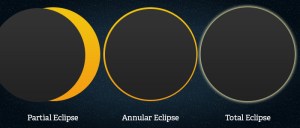
- Total eclipse – Moon passes in front of the Sun, completely blocking out its disc and briefly allowing the solar corona to be seen.
- Annular eclipse – Moon passes in front of the Sun, but the apparent size of the Moon is smaller than that of the Sun (i.e. it’s at a point further away from the Earth in its elliptical orbit than usual), causing the Sun to appear as a bright ring – annulus – around the Moon.
- Partial eclipse – Moon doesn’t pass perfectly in front of the Sun, so blocks out only a fraction of the light.

Similar to lunar eclipses, solar eclipses don’t occur every month because of the 5 degree difference in inclination (tilt) of the Moon’s and Earth’s orbits.
Different “types” of Moon
Blue Moon
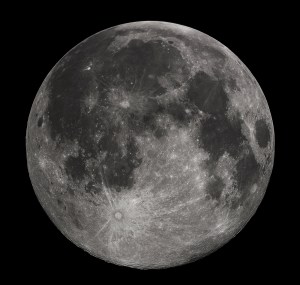
A Blue Moon (or “extra moon”) occurs when two full moons appear in the same calendar month, or when there are four full moons instead of three in a season (the third moon in this season is the Blue Moon). The moon doesn’t actually turn blue – it looks exactly the same as a regular full moon. The name was originally “belewe”, which means “betrayer”, in reference to how people would have to fast for longer in Lent if there was a Blue Moon. The phrase “once in a blue moon” comes from the rarity of Blue Moons, as they only occur every 2-3 years.
Black Moon
A Black Moon, similar to a Blue Moon, occurs when two new moons appear in the same calendar month, or when there are four new moons instead of three in a season. A Black Moon can also occur when there are no full moons, or no new moons, in a calendar month. It is no different to any other new moon – you can’t see the “dark side” of the moon, and the end of the world is not nigh. There is, however, a cultural link between this calendar event and some aspects of paganism.
Blood Moon
“Blood Moon” has most recently been used to describe total lunar eclipses that occurred in a series of four (tetrad) that occurred in 2014-15. This term, in its current usage, was coined by two Christian ministers (who claimed that this tetrad was a sign of the apocalypse) and popularised by the media.
Super Moon
A Super Moon is when the moon is at its closest point to the Earth in its orbit. As you may already know, orbits tend to be slightly elliptical – not circular – which gives rise to points where the moon is slightly closer (perigee) or farther (apogee) than average. This makes the moon appear slightly larger in the sky, though this isn’t very noticeable. Approximately every 14th full moon is a Super Moon.
Harvest Moon
The Harvest Moon is the full moon closest to the autumnal equinox (an equinox occurs when day and night are of approximately the same length all over the world). The full moon that occurs after the Harvest Moon is called the Hunter’s Moon. Again, these do not look any different to your regular full moon. There are many other names for moons depending on where they fall in the calendar – you can see a more complete list here.
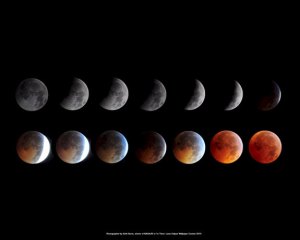
Featured photo: Stages of the Super Blood Moon lunar eclipse on 28th September 2015, taken by Nikki Miller (that’s me!). Information for this post was sourced through various websites and articles suggested by Google searches, and my own knowledge. If you find any inaccuracies, please throw a citation at me and I’ll see what I can do to correct it.
 Nikki Miller, PhD
Leave a comment