
Very precise measurements of stars in eclipsing binary systems
Detailed knowledge of the properties of stars, such as the mass, radius, effective temperature, atmospheric composition, luminosity and age, is essential for underpinning our understanding of astrophysics. Precise photometry from TESS, Kepler or CHEOPS, along with high-resolution spectroscopic facilities, have made it possible to measure masses and radii for stars in detached eclipsing binaries (DEBs) to sub-0.5% accuracy, and in some favourable cases to better than 0.2% (Maxted et al., 2020). Achieving such a level of precision is difficult or impossible for most single stars.
The catalogue of well-studied DEBs (DEBCat) shows the precision of surface gravity (log-g) that can be obtained from fits to high quality light curves and radial velocity measurements. The yellow points are stars I have worked on:
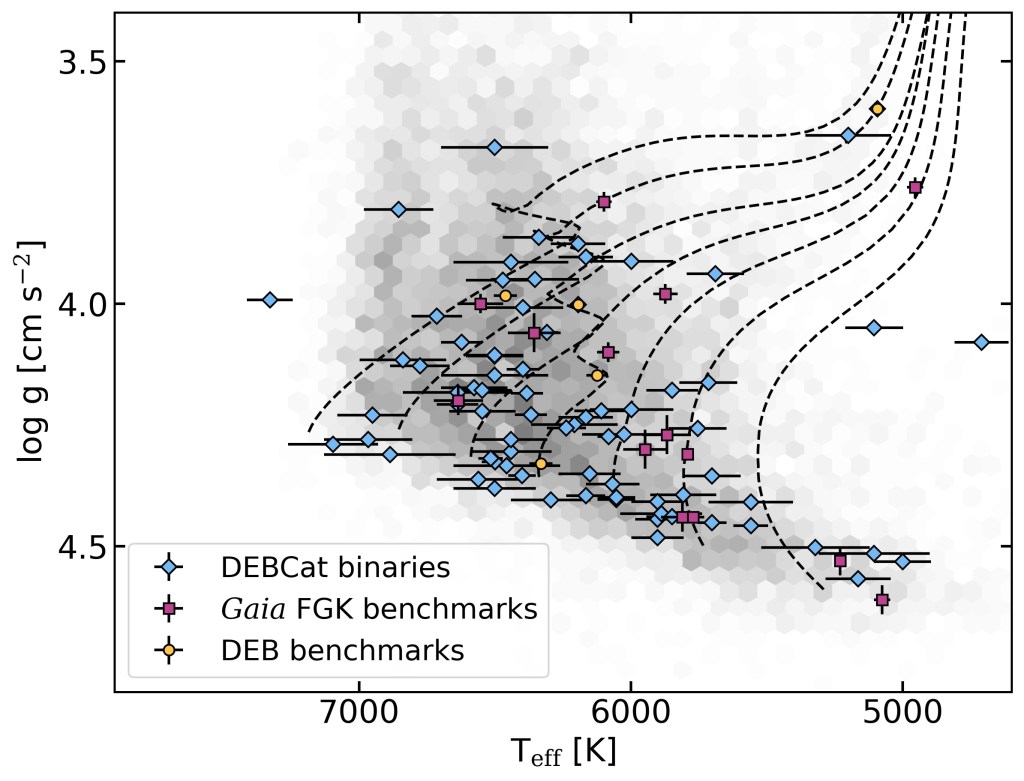
As you can see in the figure, while masses and radii are generally very well constrained, effective temperatures (Teff) are lagging behind. This is an area I’ve been exploring at length in my research.
 Nikki Miller, PhD